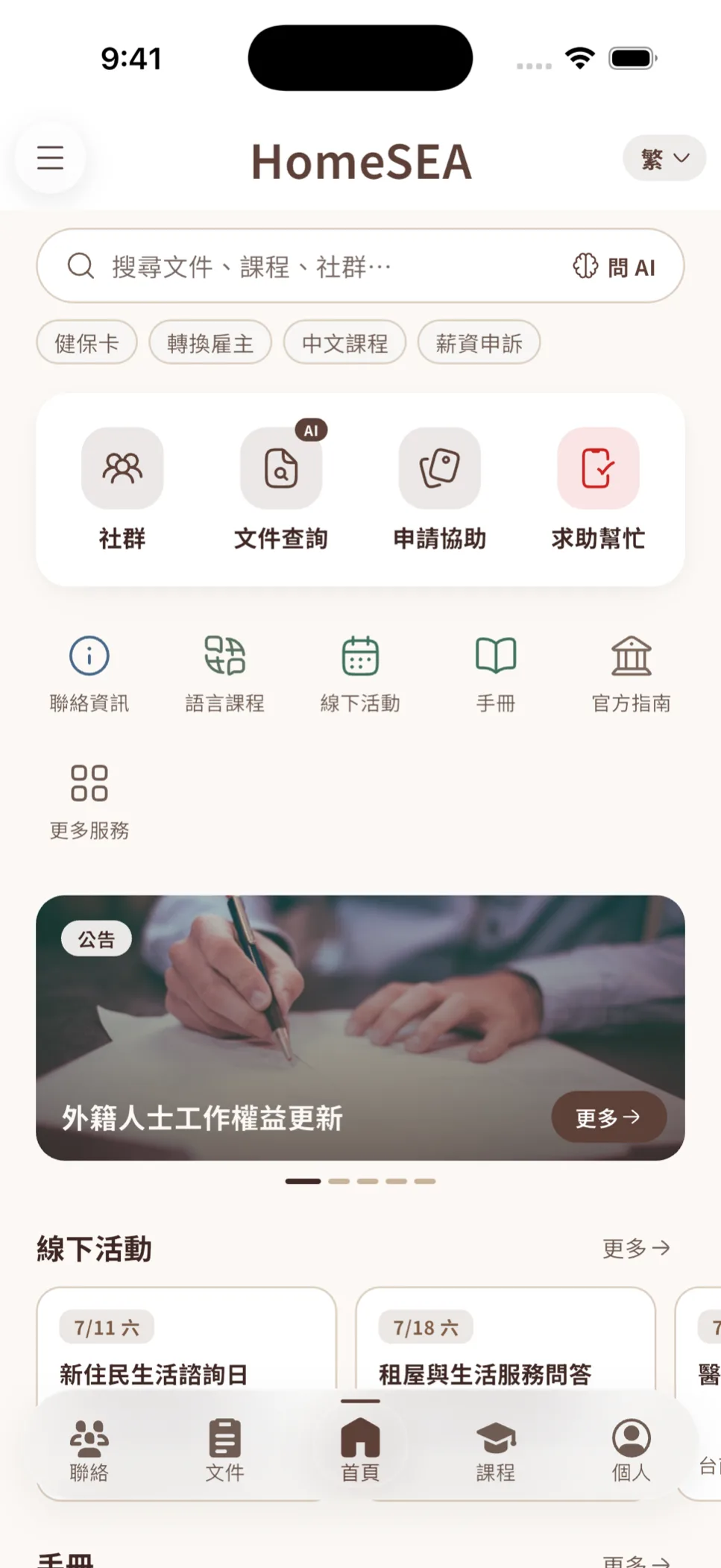
Anchor Digital Technology × HomeSEA

Migrant workers understood.
Employers see risk earlier.

A multilingual guide to Taiwan's systems: workers understand their rights and explain problems in their own language; employers see risk before it becomes a dispute.

  • 中文
  • Tiếng Việt
  • Bahasa Indonesia
  • Tagalog
  • ภาษาไทย
  • English

The problem isn't a lack of information. It's that the information is never truly understood.

When a problem isn't understood, it can slowly turn into a labor dispute, staff turnover, an outside complaint, or a compliance risk for the company.

InformationUnderstandingExpressionResolution

Scene one

What migrant workers face

The information exists, but it can't always be read, found, or put into words.

  1. Can't read it

    Contracts, pay slips, and official letters are all in Chinese. The information exists, but it can't always be read.

  2. Don't know who to ask

    Government, employers, brokers, 1955, and NGOs each handle one piece. When something goes wrong, it's unclear which door to knock on.

  3. Don't know how to say it

    Language, culture, and the employment relationship leave the story half-told, and speaking up feels risky for the job.

  4. Problems surface too late

    Small frictions over wages, dorms, or management have no outlet, and grow into serious incidents.

Scene two

On the same day, the management side sees the other half of the story.

What employers face

The systems are in place, but problems can still be seen too late.

  1. Unclear reports

    Messages arrive without the time, place, what happened, or what's expected, so managers check back and forth.

  2. Training done doesn't mean understood

    Documents were handed out and training was done, but no one can confirm workers understood them or would use the complaint channel.

  3. Scattered records

    HR, supervisors, dorm staff, and brokers each use paper, chat apps, or their own forms, so incidents are hard to track.

  4. Compliance risk seen too late

    By the time it reaches an outside complaint, a customer audit, or a government procedure, the cost is already high.

First make one message clear, then hand it to the existing process. One scenario shows how a message travels through four steps.

Vietnamese message・Sample scenario

"Lương tháng này bị trừ nhiều quá, em không biết phải làm sao..."

No time, no place. Only emotion.

Why we started

In the same sea, we find home.

“ In the same sea, we find home. ”

  • Lower communication costs

    Less time spent by managers checking and rechecking what a problem is about.

  • Spot risk earlier

    An easier way to raise issues before they turn into formal disputes or outside incidents.

  • Better understanding of information

    Not just delivering documents, but helping partners confirm whether the information actually reached the people using it.

  • Traceable records

    Fuller management records of how problems were raised, handled, and improved.

We're looking for partners

Start from real-world use and build solutions that fit the front line, together.
We're open to needs interviews and field pilots with employers, government agencies, local service units, and nonprofits.

Bạn là người lao động?・Ikaw ba ay migrant worker?

Glad you're here.

HomeSEA is a multilingual navigator built for migrant workers in Taiwan, so everyone can understand their rights and find the next step in their own language.